THOUGHT AND OPINION
Hello! Yall met me again, now I will explain the material about
opinion and thought.
OPINIONS
Is one of the English material that you have ever
been in school. This material was obtained during middle school and was studied
again in high school. Everything that happens in this life, of course,
everthing that raise, of course. everthing that raise the pros and cons. Then
people give their views or opinions about events that are happening.
no need to go far into the world, everthing happens
in the family environment there must be a cause for dissent. well, state an
opinion called material, let's just look at the following content :
ASKING AND GIVING OPINION
asking and giving opinion is a question that is used
to ask, answer or respond to an opinion. In opinion, usually several verbs are
used, among others believe, reckon, think, doubt, assume, agree or don't agree.
OPINION OF USE
regarding the use of expressing opinion is no
different from the understanding of expressing opinion that has been understood
before. In the application of daily life, the purpose and use expressing
opinion is to express opinions, ideas or opinion from the perspective of others
about a phenomenon ( topic of discussion ) that occurs.
when we negotiate, submit opinions, or chat with
friends, we often say/ask for approval or disagree with others. however, we do
not need to debate our own opinions, so we must know how to show empathy with
various opinions and also disagree without working on what is called
monotonous. we need to express our opinions and, at the same time, show we
listen, understand and win other opinions. If they feel comfortable, they will be
more open to our ideas, opinions or suggestions.
In this article, i will provide a complete overview
of how to use request and give opinions that you can apply in your daily
life.
ASKING OPINION
asking for opinion is asking about an idea, ideas,
opinions about others.
EXPRESSION OF ASKING OPINION
here I give some sample sentences about how someone
ask their opinion.
Formal:
- Have you got any comments on …..
- Do you have any idea?
- Do you have any opinion on ……
- Would you give me your
opinion on……….?
- What is your reaction to ……
- What is your opinion
about……….?
- What are you feeling
about………….?
- What are your views on……….?
- Please give me your frank
opinion?
Informal
- What do you think of…….?
- What do you think about………?
- What is your opinion?
- Why do they behave like that?
- Do you think it’s going?
- How do you like?
- How was the trip?
- How do you feel about this
diction?
GIVING OPINION
giving for opinion is give about an idea,
ideas, opinions about others.
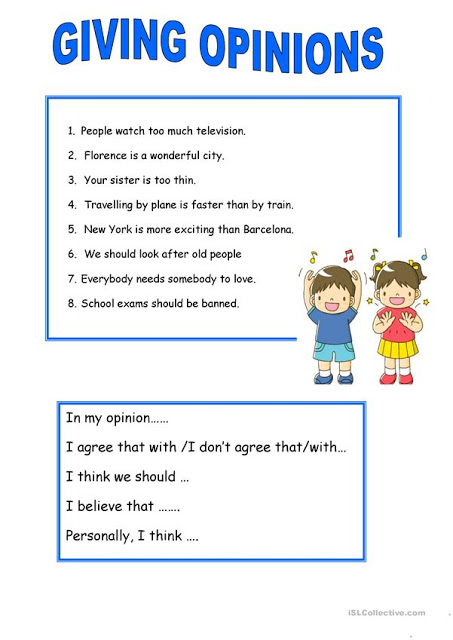
Giving opinion
Formal :
- I personally believe …..
- I personally consider ….
- I personally think /feel ….
- I hold the opinion ….
- My own view of the matter is
……
- Well, personally …….
- If I had my view, I would …..
Informal
- I think I like it.
- I don’t think I care for it.
- I think it’s
good/nice/terrific……..
- I think that awful/not
nice/terrible…………
- I don’t think much of it.
- I think that……..
- In my opinion, I would
rather……….
- In my case …..
- What I’m more concerned with
….
- What I have in my mind is………
- The way I see is that…………
- No everyone will agree with
me, but ….
- To my mind …..
- From my point of view ….
- If you aks me, I feel ….
- Absolutely ………
Generally:
- Some
people believe that............
- Some
people say that.........
- It
is considered..............
- Almost
everyone.............
- Most
people agree with...............
Examples of Agreeing and
Disagreeing Opinion
Every opinion or opinion
expressed by someone is certainly encouraging and also not. In English it is
called Agreeing and Disagreeing Opinion. The following are some examples of
disclosures

Agreeing with an
Opinion
• Of course.
• This is absolutely right.
• I agree with this opinion.
• I agree with your Opinion.
• That’s a good point.
• I think so too.
• I couldn’t agree more.
• I agree with what you are saying.
• I agree, I never thought of that.
• Neither do I.
Disagreeing with an
Opinion
• I am sorry, I don’t agree with you.
• I can’t say I agree with this, and here’s why…..
• I do not believe that.
• By this I mean…..
• I disagree with you.
• I think you are wrong.
• That’s not the same thing at all.
• I am not sure I agree with you.
• I don’t agree with you.
• I am afraid I have to disagree with you.
• It is not justified to say so.
• I am not convinced that…..
THOUGHT

Defintion and Using
Thoughts (Conjunction)
Though as a
conjunction (conjunction) starts an adverbial clause and relates it to the main
clause in a complex sentence. The adverbial clause can be in front or in the
middle of a sentence. If in front of a sentence, a comma is usually pinned
afterwards to separate it from the main clause.
Though at the
Beginning of Sentence:
adverbial clause
(though + S + V +/- ...) +, + main clause (S + V +/- ...)
Thoughts at the End of
Sentences:
main clause (S + V +/-
...) + adverbial clause (though + S + V +/- ...)
This conjunction is
used in a statement (adverbial clause) which makes the main statement (main
clause) sound surprising or surprising. The meaning is "despite of the
fact that" (despite the fact that). Synonym although
In addition, although
it can also be used to add facts or opinions that cause the previous
statement to be less true, less strong , or less important.
Apart from being a conjunction,
although it can also be used as an adverb.
Hyphen though it can
be used in several contexts at the same time which differ from one another.
There are many ways to use it though in sentences.
But the most common is
to use the word though at the end of the sentence, to show contrast or
comparison with the previous sentence.
In a dictionary, the
definitions though are:
Despite the fact that
However
In the
"however" context, though use is as an adverb. So it is easy for us
to understand in Indonesian that even though it is "though".
This word has been
known since 1150 in the Middle English era. The pronunciation though is to
disguise the letters which don't even sound at all.
To clarify, let us
consider some examples of usage though in the following sentence:
·
“There’s enough like that kind, though interrupted
Uncle John.
·
The mass was an ornate one, though not
more so than they were accustomed to at Beaulieu.
·
He felt morally bound to get it
repaired, though he was guiltless of the damage.
·
Though younger
than myself, she reciprocated the love she had inspired.
Thought use
The use of Thought in English can be in the form of simple past
tense when used as verb 2, and if thought is used as verb 3, then the form is
present or past perfect tense. Whereas in the form of nouns, thought is used as
an object.
The following is an example of using thought in simple past
tense, perfect tense and as noun.
Examples of Using Thought in Simple Past Tense
1. I
Thought I would never meet you again.
2. I thought
He sent a letter last morning.
3. My
mother tought I cooked fried rice for dinner.
4. I
thought They were at the school library yesterdat aftenoon.
5. He
thought I was arrived last night at home.
6. I
can’t believe my boyfriend did something I thought he wouldn’t.
7. We
never thought his would happen.
Examples
of using Though In Perfect Tense
1. I
thought you have bought a new car.
2. My
mother thought my sister has started a new job this week.
3.
She has thought about getting much money when she only worked as a
waiter.
4. My
friend hasn’t tought I can do it.
5. I
thought my student’s have improved their English.
Examples
of using Thought as a noun
1. I
can’t get rid of the thought of afraid him.
2.
After this incident he could not stop Thought about it.
3.
When the night comes, it’s getting harder to avoid this sleepy thought.
4.
Everyone has their own thought for their future.
5.Although
we are different but we have the same thought.
DIALOGUE ABOUT THOUGHT AND OPINION
oka : hi akmal
adis : hi oka
oka : have you trained for tournament tomorrow?
adis : no, i think i'm good enough
oka : i think you can't underestimate them, you should practice more
adis : your opinion, you can keep it, i'm undefeated, i really don't need it


