Wednesday, September 2, 2020

LETTER WRITING


LETTER WRITING 


 A letter is a written message that can be handwritten or printed on paper. It is usually sent to the recipient via mail or post in an envelope, although this is not a requirement as such. Any such message that is transferred via post is a letter, a written conversation between two parties.


Now that E-mails (Advantages and disadvantages) and texts and other such forms have become the norm for communication, the art of letter writing has taken a backseat. However, even today a lot of our communication, especially the formal kind, is done via letters. Whether it is a cover letter for a job, or the bank sending you a reminder or a college acceptance letter, letters are still an important mode of communication. Which is why it is important that we know the intricacies of letter writing.


social fuction :         


personal letters are letters that are written to people we know such as friends, parents, siblings, and caousin. letters are not only written to inform but srengthen the bond between two people writing to each other.


 Mail function Some of the functions include:


Means of notification

Means of request

Idea

Ideas or ideas

As a reminder

Historical evidence

Work guidelines


Types of letter


Let us first understand that there are broadly two types of letter, namely Formal Letters, and Informal Letters. But then there are also a few types of letters based on their contents, formalities, the purpose of letter writing etc. Let us have a look at the few types of letters.

·         Formal Letter: These letters follow a certain pattern and formality. They are strictly kept professional in nature, and directly address the issues concerned. Any type of business letter or letter to authorities falls within this given category.


·         Informal Letter: These are personal letters. They need not follow any set pattern or adhere to any formalities. They contain personal information or are a written conversation. Informal letters are generally written to friends, acquaintances, relatives etc.


·         Business Letter: This letter is written among business correspondents, generally contains commercial information such as quotations, orders, complaints, claims, letters for collections etc. Such letters are always strictly formal and follow a structure and pattern of formalities.


·         Official Letter: This type of letter is written to inform offices, branches, subordinates of official information. It usually relays official information like rules, regulations, procedures, events, or any other such information. Official letters are also formal in nature and follow certain structure and decorum.


·         Social Letter: A personal letter written on the occasion of a special event is known as a social letter. Congratulatory letter, condolence letter, invitation letter etc are all social letters.


·         Circular Letter: A letter that announces information to a large number of people is a circular letter. The same letter is circulated to a large group of people to correspond some important information like a change of address, change in management, the retirement of a partner etc.


Formal Letters

A formal letter is one written in a formal and ceremonious language and follows a certain stipulated format. Such letters are written for official purposes to authorities, dignitaries, colleagues, seniors, etc and not to personal contacts, friends or family. A number of conventions must be adhered to while drafting formal letters. So let us take a look at a sample format of a formal letter.

structure of a Formal Letter


As we said earlier, a formal letter must follow certain rules and conventions. Such a format helps in relaying the information in a professional way. It must be remembered that there are various such formats for formal letters that people follow. The one explained here is the one most commonly used for formal communicationthese days.

Sender’s Address

The sender’s address is usually put on the top right-hand corner of the page. The address should be complete and accurate in case the recipient of the letter wishes to get in touch with the sender for further communication.

Date

The sender’s address is followed by the date just below it, i.e. on the right side of the page. This is the date on which the letter is being written. It is important in formal letters as they are often kept on record.

Receiver’s Address

After leaving some space we print the receiver’s address on the left side of the page. Whether to write “To” above the address depends on the writer’s preference. Make sure you write the official title/name/position etc of the receiver, as the first line of the address.

Greeting

This is where you greet the person you are addressing the letter to. Bear in mind that it is a formal letter, so the greeting must be respectful and not too personal. The general greetings used in formal letters are “Sir” or “Madam”. If you know the name of the person the salutation may also be “Mr. XYZ” or “Ms. ABC”. But remember you cannot address them only by their first name. It must be the full name or only their last name.

Subject

After the salutation/greeting comes the subject of the letter. In the centre of the line write ‘Subject” followed by a colon. Then we sum up the purpose of writing the letter in one line. This helps the receiver focus on the subject of the letter in one glance.

Body of the Letter

This is the main content of the letter. It is either divided into three paras or two paras if the letter is briefer. The purpose of the letter should be made clear in the first paragraph itself. The tone of the content should be formal. Do not use any flowery language. Another point to keep in mind is that the letter should be concise and to the point. And always be respectful and considerate in your language, no matter the subject of your letter.

Closing the Letter

At the end of your letter, we write a complimentary losing. The words “Yours Faithfully” or “Yours Sincerely” are printed on the right side of the paper. Generally, we use the later if the writer knows the name of the person.

Signature

Here finally you sign your name. And then write your name in block letters beneath the signature. This is how the recipient will know who is sending the letter.

Example formal letters  


Informal Letters

Informal letters are written to close acquaintances of the writer, their friends, family, relatives, etc. Since they are written to close relations the letters have an informal and personal tone. Casual language is used while writing informal letters. And sometimes the letters may even have an emotional undertone.

Informal letters are mainly used for personal communication. So they do not have to follow any specific pattern, format or conventions. They can be written as per the writer’s wishes and the requirement of the situation. So the letter is written in a personal fashion in casual unassuming language.

Structure of Informal Letter


As we discussed earlier there is no set format when writing an informal letter. But there is a general pattern, some conventions that people usually follow. We will be looking at this pattern and certain tips on how to write effective and attractive informal letters. These can act as guidelines when you are drafting a letter, they are not hard and fast rules. Let us begin.                     

    Address

The first thing to write is your address, i.e. the address of the writer. We usually write the address on the left-hand side of the page at the very top. The address should be accurate and complete. Even when writing to close friends or relatives the address must be written, so they can reply back to the letter with ease. If the recipient of the letter is in another country, do not forget to write your country as well in the address.

Date

Next just below the address we write the date. This allows the reader to have a reference as to when the address was written. He can then relate better to the contents of the letter.

Greeting

Now since you know the person you are writing to, the greeting can be informal as well. If it is a friend or someone close to your age you can greet them by their first name, like “Dear Alex”. If you are writing to your relative like your mother/father/aunt/uncle etc, you may greet them as such, for example, “Dear Mom”. And if you are writing to an elder person, someone you respect greatly you can address them as Mr or Mrs. Like say for example you were writing a congratulatory letter to your teacher, it can be addressed as “Dear Mrs. Alex”.

Introduction Paragraph

And now we begin writing the actual letter. The introductory paragraph sets the tone for the whole letter. You might begin by asking the recipient about their well being. Or you may say that you hope the letter finds them in good health and great spirits. The opening of informal letters should be casual and comforting. It must not be formal and direct as in business letters.      

 Body of the Letter

The letter overall should maintain a friendly tone. But you have to adjust the language and the wordings according to who you are writing to. With a friend, you can afford to be very casual and flippant even. But if you are writing to an elder relative, you must be extremely respectful and considerate. One way to determine the tonality of your letter is to remember how you talk to the person in a conversation. And then apply the same syntax and sentiments to the letter.

Conclusion

In the conclusive paragraph sum up the reason for writing the letter, i.e. summarize the letter. Say a meaningful and affectionate goodbye to the reader. And do not forget to invite the reader to write back or reply to your letter. It shows an intention to keep the conversation going.

 Signature

There is no one way to sign off informal letters. Since they do not follow a strict format, you may sign off as you please. Some commonly used phrases are

·         Lots of Love

·         Best,

·         Best Wishes,

·         Kind Regards,

·         Kindly

 Example informal letters


DIALOGUE ABOUT LETTER WRITING


oka:when will you write a letter to ask permission to your parents ?

akmal: i will write it tonight, how about you? 

oka: maybe i will write it tomorrow morning 

akmal: why don’t we write it to our parents right now? 

oka: I want to do it with you right now , but I’m going to go to the movie tonight.


Monday, August 24, 2020

EXPOSITION TEXT

Exposition: Definition, Generic Structure, Language Features, and Examples

Definition:


     Hortatory exposition is a type of exposition text that begins with a statement containing the problem / issue which is used as the theme of the writing, then supported by various arguments / statements and supporting evidence that can lead the reader to the author's point of view and closes with suggestions or recommendations from the author. what should have been done or happened in relation to the problem or issue presented at the outset.

    Slightly different from hortatory exposition, analytical exposition is a type of exposition text that begins with a statement that shows the attitude, opinion, statement or position of the author on the theme being discussed which is then supported by various arguments and closes with an affirmation or restatement of the opinion stated at the beginning.

Purposes:


       1.      To persuade the readers that idea is important matter. 


       2.      To persuade the readers or listeners that there is something that, certainly, needs to get attention


       3.      To analyze a topic and to persuade the reader that this opinion is correct and supported by arguments

Generic Structures:


       1.      Thesis (Introduction): Introducing the topic and indicating the writer’s position


       2.      Arguments (Body): Explaining the arguments to support the writer’s position.


       3.      Reiteration (Conclusion): Restating the writer’s position.

Language Features:


      1.      Using relational process = Relationships between and among leaders, workers, followers, partners, co-workers, etc. people knowing and caring about people.


      2.      Using external conjunctions = Enhancing by linking to real world events (Holocaust, the Final Solution, death trains) 


      3.      Using internal conjunction = Elaborating and itemizing steps in an argument (Firstly, secondly, next, finally) 


      4.      Using causal conjunction = the cause of an event, because


      5.      Using contrastive conjunction = but, nevertheless 


      6.      Using simple present tense = Bruno is quiet boy


      7.      Focusing on generic human and non-human participants, e.g.: car, pollution, leaded petrol car


      8.      Using abstract noun, e.g.: policy, government


      9.      Using relational processes, e.g.: It is important


      10.   Using modal verbs, e.g.: We must preserve


      11.   Using modal adverbs, e.g.: Certainly we.


      12.   Using passive sentence

Example of Exposition 1

Why is breakfast important? “Breakfast like a King, Lunch like a Prince and Dine like a Pauper” It’s a well known

Breakfast prepare many benefits to our health and wellbeing. Breakfast prepare the body and brain with fuel after an overnight fast – that’s where its name originate, breaking the fast! Without breakfast you are effectively running on empty, like trying to start the car with no petrol!

Breakfast support cognitive function. Breakfast also restores glucose levels, an essential carbohydrate that is needed for the brain to function. Breakfast provides energy, studies have shown how eating breakfast can improve memory and concentration levels and it can also make us happier as it can improve mood and lower stress levels.

Breakfast provides energy needs. People’s energy needs vary depending on activity levels and life stage but typically men need more energy than women. Growing children need a lot of energy, as an example boys aged 7-10 years should consume around 1970 kcals per day, and girls aged 7-10 years should consume around 1740kcals


Wednesday, August 5, 2020

INVITATION CARD

INVITATION CARD 
1.WHAT IS AN INVITATION CARD AND WHAT IT IS USED FOR?
An invitation is a document written or printed or spoken
words, conveying the message by which one is invited.

It is used to invite someone to come, to invite people to join,
to ask someone to attend, and to ask people to take part in
something

There are two kinds of invitation letter;
1. Formal invitation
2. Informal Invitation

2.WHAT IS FORMAL INVITATION 
Informal invitat ion is an invitat ion which follows a
dignified form, tone or style in agreement with an
establish norm, custom or values. ( Websters,
2012).

For example; - An invitation to a wedding
- An Invitation to the graduation
ceremony

Structure and Examples of Formal Invitations 

Before entering into the formal invitation example, you should first learn what structures it uses. Both in terms of language style, sentence structure and phrases used. The following structure must be used

different examples of formal and informal invitations
The difference between formal and informal invitations is on several factors. First is the language style. At formal invitations the style of language used is polite while informal is more relaxed. So that formal invitation is used on formal or important types of events. The second difference is structure or pattern.

In formal invitations there are certain patterns that must be followed especially in English. Because the scale of people downloaded is quite large and could have a high position. The structure must be clear and complete. Whereas informal invitations only need to convey complete information, so the structure is usually not given much attention.

 INFORMAL INVITATION CARD
is personal invitation given to a friend , family , etc. 
for example : birtday party etc

EXAMPLE INFOORMAL INVITATION CARD 
And this is mine 
DIALOG ABOUT INVITATION CARD :

Formal
Oka : Hello ,this is my Oka may i speak to Adis
Adis : Hello, Adis is speaking now
Oka : Oh hi Adis , i wonder if you'd like to come to my house right now. Were had a party to celebrate my success on entered into the Indonesia university.
Adis : i don't think i can . Im doing my home work .
Oka : thats alright.
Adis: i hope you enjoy your party Oka. Bye
Oka: ok bye

INFORMAL
Oka: hi Adis, what Will you do tomorrow morning?
Adis: not much, what did you have in mind?
Oka: would you go to my brother birthday party?
Adis : sure sounds like fun. What time and what should i meet ?
Oka: the party open at 9 pm . How about 10pm? At Hogwarts ,griffyndor house .
Adis : sounds great , see you there.
Oka: see you


Wednesday, July 29, 2020

THOUGHT AND OPINION


THOUGHT AND OPINION


Hello! Yall met me again, now I will explain the material about opinion and thought.

OPINIONS

Is one of the English material that you have ever been in school. This material was obtained during middle school and was studied again in high school. Everything that happens in this life, of course, everthing that raise, of course. everthing that raise the pros and cons. Then people give their views or opinions about events that are happening.

no need to go far into the world, everthing happens in the family environment there must be a cause for dissent. well, state an opinion called material, let's just look at the following content :


ASKING AND GIVING OPINION

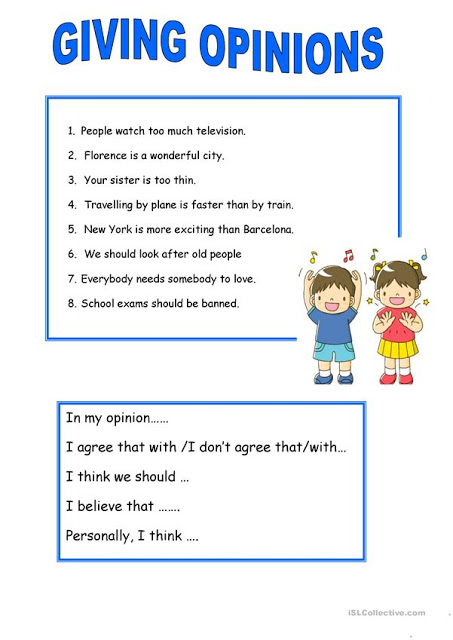
asking and giving opinion is a question that is used to ask, answer or respond to an opinion. In opinion, usually several verbs are used, among others believe, reckon, think, doubt, assume, agree or don't agree.


OPINION OF USE

regarding the use of expressing opinion is no different from the understanding of expressing opinion that has been understood before. In the application of daily life, the purpose and use expressing opinion is to express opinions, ideas or opinion from the perspective of others about a phenomenon ( topic of discussion ) that occurs.


when we negotiate, submit opinions, or chat with friends, we often say/ask for approval or disagree with others. however, we do not need to debate our own opinions, so we must know how to show empathy with various opinions and also disagree without working on what is called monotonous. we need to express our opinions and, at the same time, show we listen, understand and win other opinions. If they feel comfortable, they will be more open to our ideas, opinions or suggestions.

In this article, i will provide a complete overview of how to use request and give opinions that you can apply in your daily life. 

ASKING OPINION 

asking for opinion is asking about an idea, ideas, opinions about others.


EXPRESSION OF ASKING OPINION

here I give some sample sentences about how someone ask their opinion.


Formal:

- Have you got any comments on …..

- Do you have any idea?

- Do you have any opinion on ……

- Would you give me your opinion on……….?

- What is your reaction to ……

- What is your opinion about……….?

- What are you feeling about………….?

- What are your views on……….?

- Please give me your frank opinion?


Informal

- What do you think of…….?

- What do you think about………?

- What is your opinion?

- Why do they behave like that?

- Do you think it’s going?

- How do you like?

- How was the trip?

- How do you feel about this diction?


GIVING OPINION

giving for opinion is give about an idea, ideas, opinions about others.

Giving opinion


Formal :


- I personally believe …..


- I personally consider ….


- I personally think /feel ….


- I hold the opinion ….


- My own view of the matter is ……

- Well, personally …….

- If I had my view, I would …..


Informal

- I think I like it.

- I don’t think I care for it.

- I think it’s good/nice/terrific……..

- I think that awful/not nice/terrible…………

- I don’t think much of it.

- I think that……..

- In my opinion, I would rather……….

- In my case …..

- What I’m more concerned with ….

- What I have in my mind is………

- The way I see is that…………

- No everyone will agree with me, but ….

- To my mind …..

- From my point of view ….

- If you aks me, I feel ….

- Absolutely ………


Generally:

-          Some people believe that............

-          Some people say that.........

-          It is considered..............

-          Almost everyone.............

-          Most people agree with...............


Examples of Agreeing and Disagreeing Opinion


Every opinion or opinion expressed by someone is certainly encouraging and also not. In English it is called Agreeing and Disagreeing Opinion. The following are some examples of disclosures


Agreeing with an Opinion 

• Of course.
• This is absolutely right.
• I agree with this opinion.
• I agree with your Opinion.
• That’s a good point.
• I think so too.
• I couldn’t agree more.
• I agree with what you are saying.
• I agree, I never thought of that.
• Neither do I.

Disagreeing with an Opinion 

• I am sorry, I don’t agree with you.
• I can’t say I agree with this, and here’s why…..
• I do not believe that.
• By this I mean…..
• I disagree with you.
• I think you are wrong.
• That’s not the same thing at all.
• I am not sure I agree with you.
• I don’t agree with you.
• I am afraid I have to disagree with you.
• It is not justified to say so.
• I am not convinced that…..

THOUGHT


Defintion and Using Thoughts (Conjunction)

Though as a conjunction (conjunction) starts an adverbial clause and relates it to the main clause in a complex sentence. The adverbial clause can be in front or in the middle of a sentence. If in front of a sentence, a comma is usually pinned afterwards to separate it from the main clause.


Though at the Beginning of Sentence:

adverbial clause (though + S + V +/- ...) +, + main clause (S + V +/- ...)


Thoughts at the End of Sentences:

main clause (S + V +/- ...) + adverbial clause (though + S + V +/- ...)


This conjunction is used in a statement (adverbial clause) which makes the main statement (main clause) sound surprising or surprising. The meaning is "despite of the fact that" (despite the fact that). Synonym although 


In addition, although it can also be used to add facts or opinions that cause the previous statement  to be less true, less strong , or less important.


Apart from being a conjunction, although it can also be used as an adverb.


Hyphen though it can be used in several contexts at the same time which differ from one another. There are many ways to use it though in sentences.


But the most common is to use the word though at the end of the sentence, to show contrast or comparison with the previous sentence.


In a dictionary, the definitions though are:


Despite the fact that However

In the "however" context, though use is as an adverb. So it is easy for us to understand in Indonesian that even though it is "though".


This word has been known since 1150 in the Middle English era. The pronunciation though is to disguise the letters which don't even sound at all.


To clarify, let us consider some examples of usage though in the following sentence:


·                     “There’s enough like that kind, though interrupted Uncle John.

·                     The mass was an ornate one, though not more so than they were accustomed to at Beaulieu.

·                     He felt morally bound to get it repaired, though he was guiltless of the damage.

·                     Though younger than myself, she reciprocated the love she had inspired.


Thought use


The use of Thought in English can be in the form of simple past tense when used as verb 2, and if thought is used as verb 3, then the form is present or past perfect tense. Whereas in the form of nouns, thought is used as an object.


The following is an example of using thought in simple past tense, perfect tense and as noun.


Examples of Using Thought in Simple Past Tense

1. I Thought I would never meet you again.

2. I thought He sent a letter last morning. 

3. My mother tought I cooked fried rice for dinner. 

4. I thought They were at the school library yesterdat aftenoon. 

5. He thought I was arrived last night at home. 

6. I can’t believe my boyfriend did something I thought he wouldn’t. 

7. We never thought his would happen. 


Examples of using Though In Perfect Tense

1. I thought you have bought a new car. 

2. My mother thought my sister has started a new job this week. 

3. She has thought about getting much money when she only worked as a waiter. 

4. My friend hasn’t tought I can do it. 

5. I thought my student’s have improved their English. 


Examples of using Thought as a noun

1. I can’t get rid of the thought of afraid him. 

2. After this incident he could not stop Thought about it. 

3. When the night comes, it’s getting harder to avoid this sleepy thought. 

4. Everyone has their own thought for their future. 

5.Although we are different but we have the same thought.

DIALOGUE ABOUT THOUGHT AND OPINION 

oka : hi akmal

adis : hi oka

oka : have you trained for tournament tomorrow?

adis : no, i think i'm good enough

oka : i think you can't underestimate them, you should practice more

adis : your opinion, you can keep it, i'm undefeated, i really don't need it


NARRATIVE TEXT